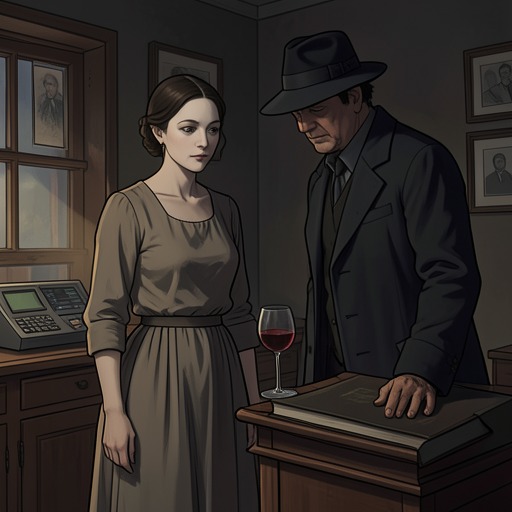
Camilla and Lothario: romance, deception, and flight together
Don QuixoteCamilla and Lothario: romance, deception, and flight together is a relationship formed inside Anselmo’s experiment in testing his wife’s virtue. Lothario’s permitted courtship becomes an actual affair, but the lovers’ secrecy does not secure them from suspicion: it instead makes them vulnerable to a chain of misread evidence, improvised performances, and concealment. Camilla’s ingenuity temporarily converts Anselmo’s own plan to observe her into apparent proof of her fidelity, yet the arrangement ends with the lovers separated and Anselmo’s trust irreparably betrayed.
The Experiment and the Affair
Anselmo had allowed Lothario to make addresses to Camilla as a means of testing her. The arrangement placed the friend who was supposed to assist Anselmo’s inquiry inside the very intimacy the inquiry was meant to examine. Camilla and Lothario’s relationship therefore developed under a double condition: it was concealed from Anselmo as an affair, but its beginnings had occurred with his permission. When Lothario later tells Anselmo that Camilla has agreed to meet him in the closet where Anselmo’s jewels are kept, he presents the meeting as a still-unfulfilled intention. The closet matters both as the proposed place of their encounter and as the spot where Anselmo plans to hide and observe.
The danger of discovery first rises through Leonela, Camilla’s maid. Camilla knows Leonela is bringing her own lover into the house at night, but her involvement with Lothario prevents her from openly reprimanding the servant without exposing her own secret. One morning Lothario sees a man leaving the house, initially mistakes him for a spectre, and then watches him depart with his face muffled. He does not recall Leonela’s lover as a possible explanation. Instead, he assumes Camilla has been unfaithful to him as she has been to her husband. His jealousy turns an ambiguous sight into an accusation, and he rushes to Anselmo before the husband has risen.
Jealousy and the Counterplot
Lothario tells Anselmo that Camilla has yielded to his approaches and describes the proposed meeting in the closet. He advises Anselmo to pretend to leave for two or three days, conceal himself among the tapestries and other furnishings, and judge her intentions firsthand. In Lothario’s account, the wrongdoing remains an intention rather than a completed act; he urges Anselmo not to act precipitately, while also giving him the means to witness what he fears. Afterward, Lothario regrets having spoken in this way and recognizes that jealousy has driven him into a reckless decision against Camilla, who had not wronged him in the way he imagined.
When he finds Camilla alone, he means to disclose his mistake. She first speaks of Leonela’s nightly visitor and explains why she cannot discipline the maid: their shared knowledge of Camilla’s own affair silences her. Lothario initially suspects that this account is a stratagem to divert him from his belief that the departing man was Camilla’s lover. Her distress convinces him otherwise. He then confesses both his jealous accusation to Anselmo and the plan for Anselmo to hide in the closet. Camilla rebukes him for creating a danger that could expose them, but sees a way to use the very concealment intended to catch her. She tells Lothario to go to her when Leonela calls him after Anselmo is hidden, and to answer her as if he did not know Anselmo was listening. She withholds the full plan, concerned that he might resist it or propose a less workable alternative.
A Performance of Fidelity
Camilla stages a confrontation designed for Anselmo’s ears. She presents herself as defending her husband’s honor and rejecting Lothario’s supposed advances; he plays the role required of him, while Anselmo listens from concealment. The performance makes the planned test reverse its apparent meaning: rather than revealing Camilla’s affair, it gives Anselmo a carefully constructed scene in which she seems to resist Lothario. To make the appearance convincing, Camilla uses a dagger in a staged attack and gives herself a slight wound. Leonela and Lothario are initially alarmed by how completely the performance seems to become real, but Lothario recognizes that Camilla has controlled the scene with composure and quick judgment.
Anselmo hears and sees the episode as proof that Camilla has preserved her fidelity. After nightfall he leaves the house to find Lothario and celebrate what he believes his friend has helped establish. Anselmo embraces him and praises Camilla; Lothario, unable to share the happiness, is conscious that his friend is being deceived and that he himself has wronged him. Anselmo interprets Lothario’s lack of pleasure as concern about Camilla’s wound, not remorse over their affair. He even proposes making verses that will preserve her name, while Lothario agrees to help him raise what Anselmo imagines will be a lasting monument to her virtue. Anselmo himself then leads the man who has helped destroy his honor back into his house, where Camilla greets Lothario with an outwardly averted expression and inward satisfaction.
Exposure and Separation
The deception continues for months, but the later crisis involving Leonela breaks the lovers’ ability to manage appearances. Anselmo locks the maid in her room after she has promised to tell him something important. Fearing that Leonela will disclose what she knows about her infidelity, Camilla does not wait to learn whether that fear is justified. During the night she gathers her most valuable jewels and some money, slips out of the house, and goes to Lothario, asking him either to find her a safe place or to flee with her. Lothario is so perplexed at first that he cannot answer. He eventually takes her to a convent whose prioress is his sister; after leaving Camilla there, he departs the city without telling anyone.
By morning, Anselmo finds Leonela gone as well: knotted sheets at the window show that she has escaped from the locked room. Searching for Camilla, he discovers her open boxes and the missing jewels. Those absences correct his earlier interpretation: Leonela was not the cause of his misfortune, and Camilla has disappeared with Lothario. He goes to Lothario’s house but learns that Lothario has been away all night and has taken his money. Returning home, Anselmo finds the household deserted, with none of the servants remaining. He understands himself to have been left without wife, friend, or servants, and to have lost the honor he had tried to test and certify.
Consequences of the Relationship
The affair’s ending is not a reconciliation. Camilla is left at the convent, and Lothario leaves the city; the evidence establishes their flight and separation from Anselmo but does not describe a later shared life. Anselmo’s imagined certainty had depended on a staged encounter, while the actual relationship between Camilla and Lothario remained hidden behind the very performance meant to expose it. The irony is sharpened by Lothario’s roles in succession: he is Anselmo’s trusted adviser, the lover whose disclosure triggers the trap, the jealous accuser who misreads Leonela’s lover, and Camilla’s accomplice in the counterplot.
The narrator later states that the concealed guilt becomes public after several months and that Anselmo pays with his life for his ill-advised curiosity. The sequence makes the test itself central to the relationship’s consequences. Anselmo’s demand for certainty creates the conditions in which Lothario and Camilla deceive him; Lothario’s jealousy nearly exposes them; Camilla’s skill preserves the deception for a time; and the later flight makes the truth unmistakable to Anselmo. Their romance is thus presented not as a private attachment insulated from others, but as an entanglement whose secrecy compromises trust and draws the household into its eventual collapse.